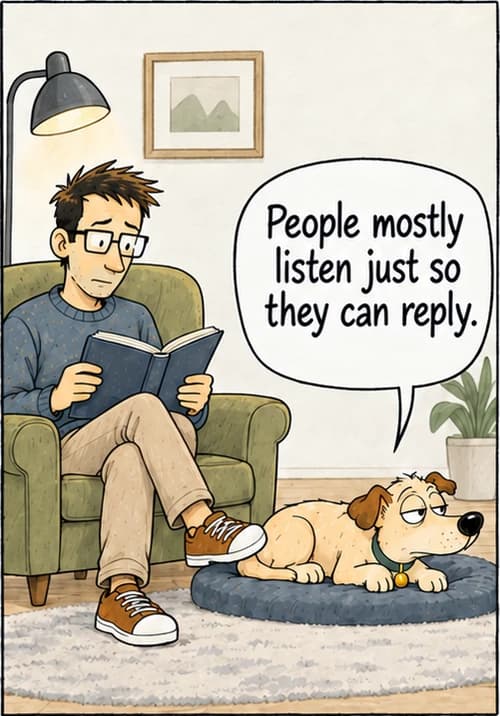
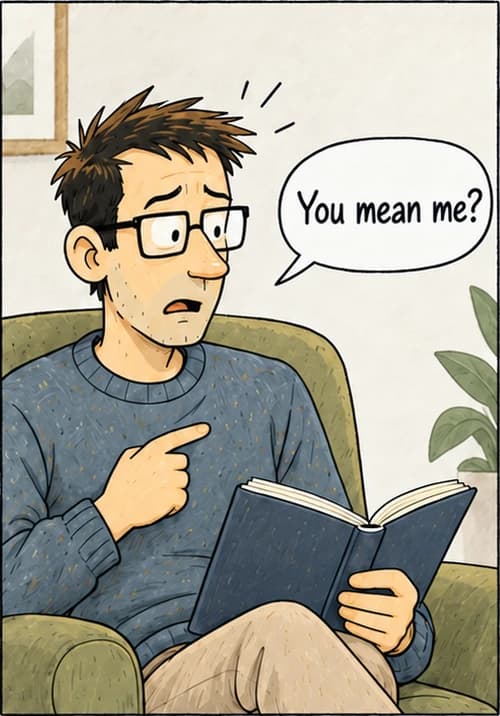
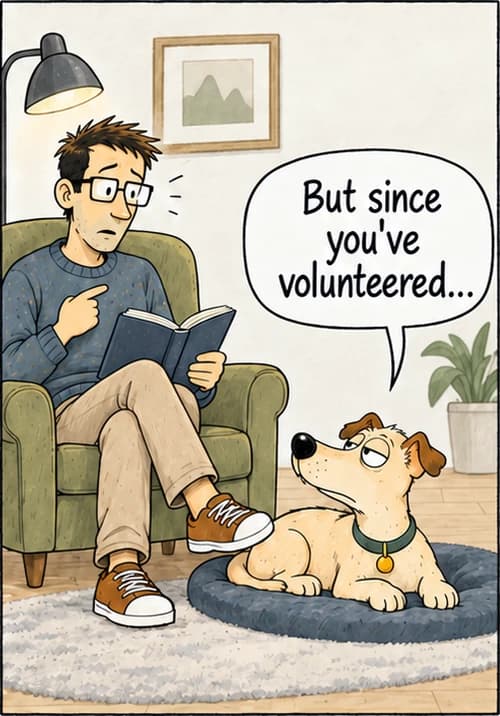
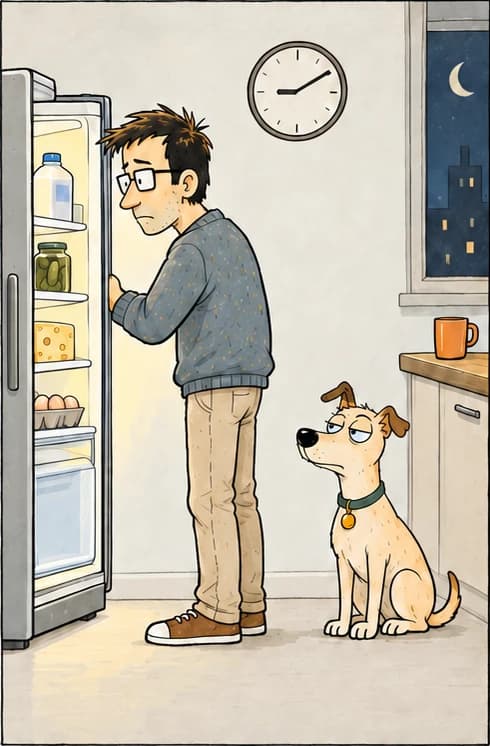
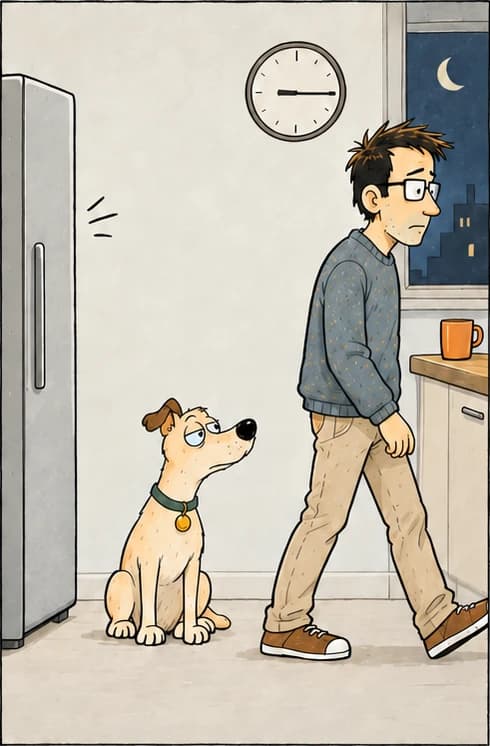
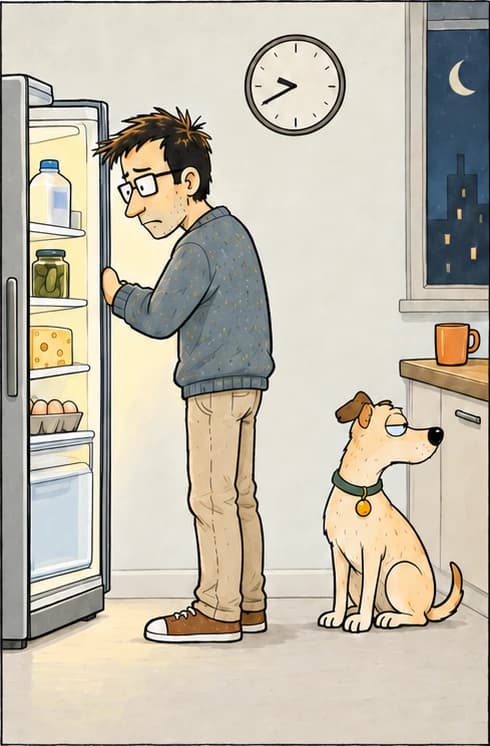
Open the fridge, look, close it. Half an hour later, again. It's still milk, pickles and cheese in there, and yet we keep coming back. Before you look at the comic, answer silently: how many times in the past week have you opened it without being hungry?
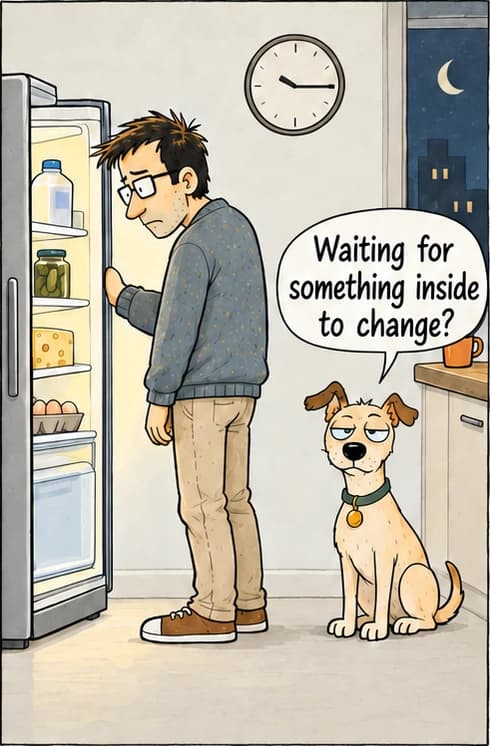
ComicThe dog talks, only the man can hear it. Below the comic: what experiments say about it.
Psíchologie, episode 1 · Not hungry
The dog asks about the fridge, but means something else. When you're not hungry and still searching, you're usually not after food. You want something to change: the boredom, the restlessness, the empty evening.
Make a guess before reading on: how many people would rather give themselves an electric shock than sit for 15 minutes just thinking?
In an experiment by Timothy Wilson and colleagues (2014), 12 of 18 men (67%) and 6 of 24 women (25%) gave themselves at least one mild electric shock during 15 minutes alone. Earlier, they had tried the shock and said they would pay not to get it again.
We're not looking for food. We're looking for something to change.
Boredom pushes us to food and even to pain. In an experiment by Remco Havermans and colleagues (2015), people watched either a documentary for an hour or one short clip from it over and over. During the boring clip they ate more M&M's, and in a second experiment they gave themselves more electric shocks. The authors conclude that when bored, we eat not for the taste but to escape the monotony.
The fridge is the nearest way out. It's a few steps away, it lights up and for a moment it promises something. But what needs to change isn't inside the fridge. So half an hour later comes the next opening.
A simple test: next time before you open the fridge, say what you're looking for. If you don't know, you're probably not looking for food. Try it on the last time you opened it. It takes one to three questions.
IllustrationIt only tells apart four common reasons based on your answers, it isn't a measurement or a diagnosis. Your answers aren't stored anywhere.

Question 1
Think of the last time you opened the fridge.
Was it really hunger?
Sources
- Wilson, T. D., Reinhard, D. A., Westgate, E. C., Gilbert, D. T., Ellerbeck, N., Hahn, C., Brown, C. L. and Shaked, A. (2014). Just think: The challenges of the disengaged mind. Science, 345(6192), 75–77
- Havermans, R. C., Vancleef, L., Kalamatianos, A. and Nederkoorn, C. (2015). Eating and inflicting pain out of boredom. Appetite, 85, 52–57
- Bongers, P. and Jansen, A. (2016). Emotional eating is not what you think it is and emotional eating scales do not measure what you think they measure. Frontiers in Psychology, 7, 1932
- Neal, D. T., Wood, W., Wu, M. and Kurlander, D. (2011). The pull of the past: When do habits persist despite conflict with motives? Personality and Social Psychology Bulletin, 37(11), 1428–1437
- Read, D. and van Leeuwen, B. (1998). Predicting hunger: The effects of appetite and delay on choice. Organizational Behavior and Human Decision Processes, 76(2), 189–205
- Kavanagh, D. J., Andrade, J. and May, J. (2005). Imaginary relish and exquisite torture: The elaborated intrusion theory of desire. Psychological Review, 112(2), 446–467
- Skorka-Brown, J., Andrade, J., Whalley, B. and May, J. (2015). Playing Tetris decreases drug and other cravings in real world settings. Addictive Behaviors, 51, 165–170
- Westgate, E. C. and Wilson, T. D. (2018). Boring thoughts and bored minds: The MAC model of boredom and cognitive engagement. Psychological Review, 125(5), 689–713
- Wood, W., Quinn, J. M. and Kashy, D. A. (2002). Habits in everyday life: Thought, emotion, and action. Journal of Personality and Social Psychology, 83(6), 1281–1297