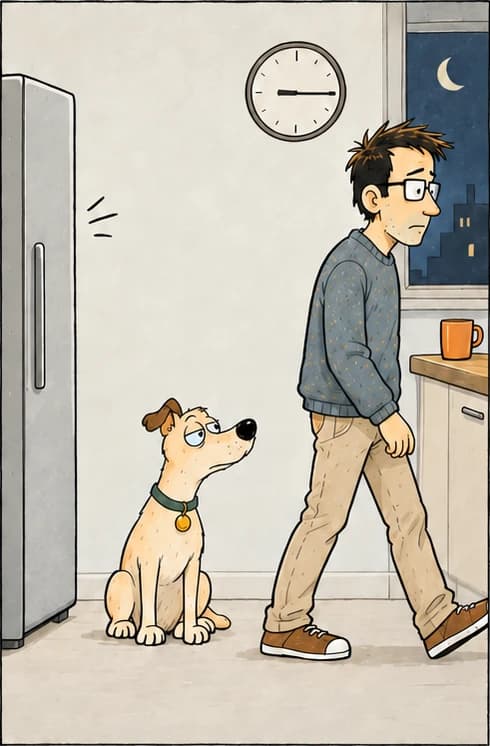
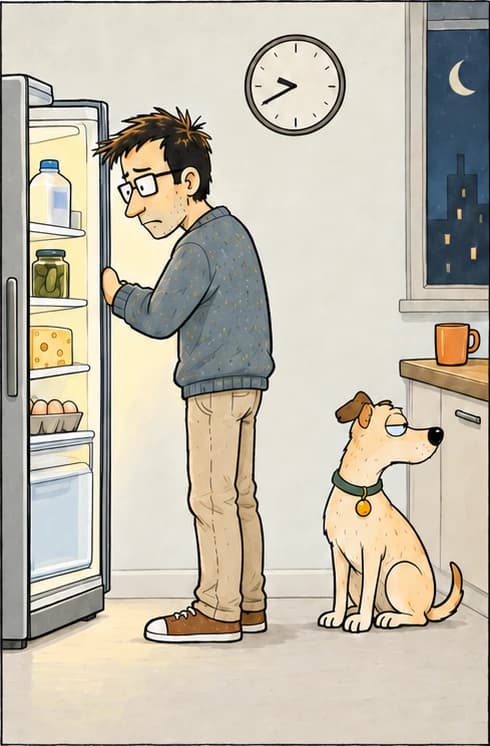
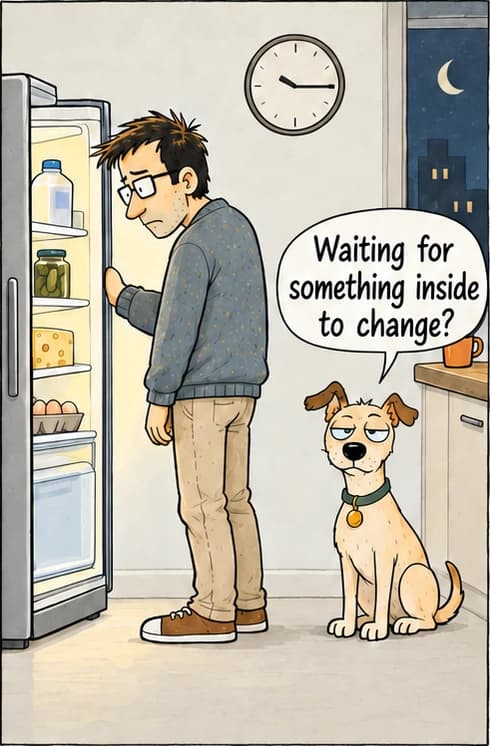
After a few weeks at home it's harder to call someone, even though nothing happened. Move the slider and see what changes. Then try one conversation.
IllustrationA demonstration of a principle, not a test. The curve is illustrative and measures nothing about you. What you enter isn't stored or sent anywhere unless you save your result yourself.
The world outside hasn't changed. Your prediction of how it will go has.
Beforehand, we overestimate how unpleasant it will be. Commuters on trains near Chicago expected talking to a stranger to be worse than sitting in silence. Those who tried it had a more pleasant ride. The conversations lasted 14 minutes on average. Yet other commuters on the same line guessed that only 46% of people would be willing to talk to them (Epley and Schroeder, 2014).
Afterwards, we underestimate the impression we made. After a conversation, people underestimate how much the other person liked them. It holds after a five-minute chat with a stranger and among college roommates, even several months in (Boothby et al., 2018). Both errors push the same way: stay home.
The shell isn't a character flaw. According to the model by Cacioppo and Hawkley (2009), loneliness heightens sensitivity to rejection and social threat. Without a group, it pays to be more careful. But that caution then reads neutral signals as rejection, and withdrawal feeds itself. The shell is protection that overshot.
Repetition helps, not willpower. In one study, people talked to strangers every day for five days in a row. Their fear of rejection dropped day by day, and the improvement lasted a week after it ended. 87% of 1,336 conversations worked out with the first person approached, and about 40% of participants swapped contacts with someone and followed up (Sandstrom, Boothby and Cooney, 2022).
One short conversation is information that corrects the prediction. Not “change yourself”, just “try one”.
Solitude you chose and feel good in isn't a shell. This article is about the moment you'd like to call someone and can't.
How it works
The model in the app is illustrative. Its shape follows the studies: people overestimate in advance how unpleasant a conversation will be, and repetition corrects that. The specific numbers aren't measured. That the prediction error grows with time alone is this article's idea, built on Cacioppo and Hawkley's model, not a measurement.
Reality is fixed at 25 out of 100. The prediction without time alone is 35 (people overestimate a little even then) and rises with weeks alone towards a ceiling of 85: error = 10 + 50 × (1 − e^(−weeks / 4)). After each conversation, 60% of the error remains. The shell is drawn according to how many weeks alone today's prediction corresponds to. Nothing is stored or sent.
Sources
- Epley, N. and Schroeder, J. (2014). Mistakenly seeking solitude. Journal of Experimental Psychology: General, 143(5), 1980–1999
- Boothby, E. J., Cooney, G., Sandstrom, G. M. and Clark, M. S. (2018). The liking gap in conversations. Psychological Science, 29(11), 1742–1756
- Sandstrom, G. M., Boothby, E. J. and Cooney, G. (2022). Talking to strangers: A week-long intervention reduces psychological barriers to social connection. Journal of Experimental Social Psychology, 102
- Cacioppo, J. T. and Hawkley, L. C. (2009). Perceived social isolation and cognition. Trends in Cognitive Sciences, 13(10), 447–454