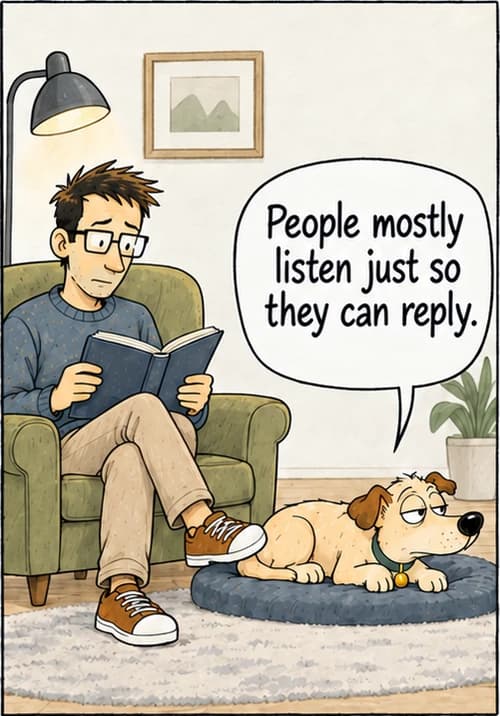
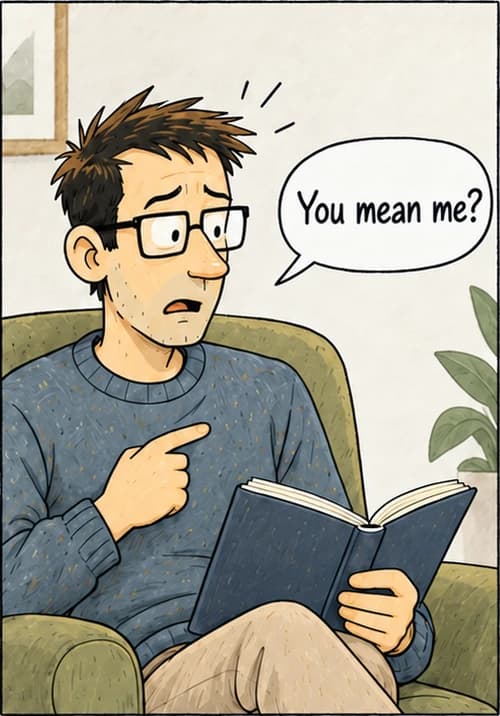
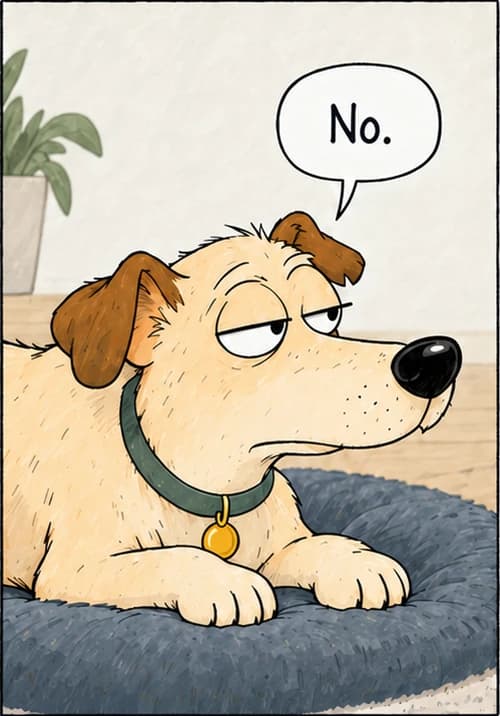
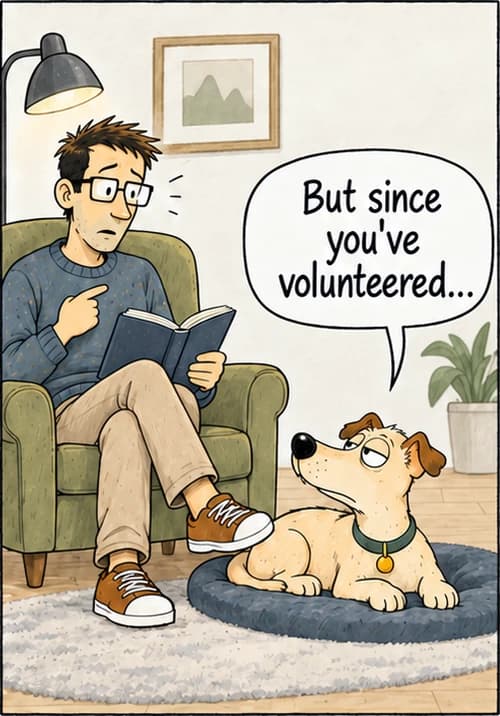
What you studied, your job, full-time work, a mortgage, a car. Many of the big things in life didn't come from a decision but from “that's just how it's done”. Try answering a single question for nine of them: why do you have it?
Your own estimateThe result comes only from your answers. It measures nothing. What you enter isn't stored or sent anywhere unless you save your result yourself.
Go through 9 things in your life. Just one question for each: why do you have it?
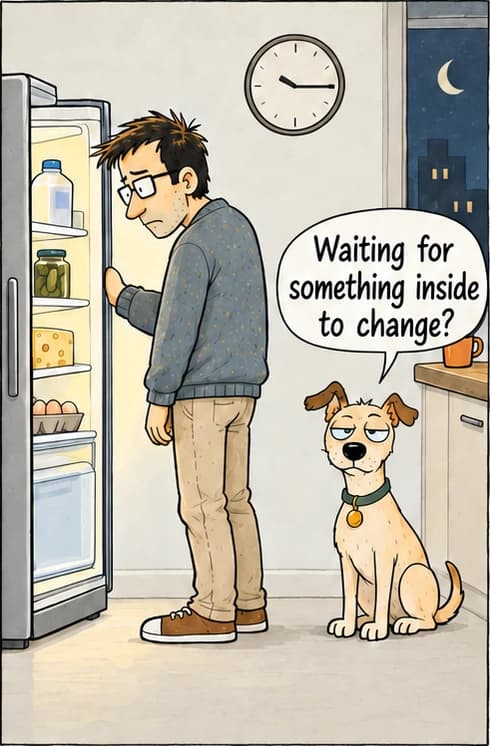
Autopilot isn't the problem. Not knowing it's on is.
Defaults are stronger than we think. When a company enrolled employees in its retirement savings plan automatically, 86% of them saved. When they had to sign up themselves, only 37% did. Three quarters also stayed at exactly the default amount (Madrian and Shea, 2001). Nobody forced them. They just didn't do anything.
And for most of the day, you need autopilot. In two diary studies, 35–43% of everything people did was habit: the same thing, almost daily, in the same place, often with their mind somewhere else entirely (Wood, Quinn and Kashy, 2002). Without habits, every morning would have to be decided from scratch. The trouble starts only when the big decisions run on autopilot too: what you studied, your work, where and how you live.
People who hesitate tend to underrate change. Economist Steven Levitt had undecided people flip a coin on whether to change something, such as quitting a job or moving (over 22,000 coin flips). For important decisions, those who made the change were happier even six months later. This holds for people who were already hesitating, not for everyone, and the author himself calls the results merely suggestive (Levitt, 2021).
You don't have to change anything. Same life, just a different driver.
It's about the reason, not the choice itself. People follow through more often on goals backed by their own reasons, and enjoy them more, than on goals that come from obligation (Sheldon and Elliot, 1999). So even a mortgage or an eight-hour job can be yours. You just have to choose it again, consciously, once. And watch out for the opposite extreme: doing everything differently just because others do it this way is steering from outside too.
How it works
The answers are based on self-determination theory (Ryan and Deci, 2000). Each thing has five answers written specifically for it, and behind each one is a type of motivation: others' expectations, inner pressure (guilt, shame, comparison), “don't know” (it was never decided), your own reason, and enjoyment. This is a simplification: the theory distinguishes six levels (amotivation, external, introjected, identified, integrated, intrinsic), we merge integration into your own reason, and “don't know” is our own category, which the theory doesn't have. Others' expectations and inner pressure count as autopilot; your own reason and enjoyment count as your own choice. The order of answers differs for each thing, and you only see the colours at the end, so there's no way to answer “correctly”.
The five rungs of awareness are a model, not a measurement. Similar stage models of behaviour change (Prochaska) have weak support in the data (West, 2005), so don't take the rungs literally. The “from your answers” hint only picks which rung to start reading from.
The name “reversal test” is borrowed loosely. Bostrom and Ord (2006) mean a different procedure against status quo bias: if changing something in one direction seems bad, imagine changing it in the opposite direction; if that seems bad too, the burden is on whoever defends the current state to explain why it is the best one. Our “if you could start from scratch” question is a simpler variation on the same idea.
Nothing is stored or sent.
Sources
- Madrian, B. C. and Shea, D. F. (2001). The Power of Suggestion: Inertia in 401(k) Participation and Savings Behavior. The Quarterly Journal of Economics, 116(4), 1149–1187
- Wood, W., Quinn, J. M. and Kashy, D. A. (2002). Habits in everyday life: Thought, emotion, and action. Journal of Personality and Social Psychology, 83(6), 1281–1297
- Levitt, S. D. (2021). Heads or Tails: The Impact of a Coin Toss on Major Life Decisions and Subsequent Happiness. The Review of Economic Studies, 88(1), 378–405
- Sheldon, K. M. and Elliot, A. J. (1999). Goal striving, need satisfaction, and longitudinal well-being: The self-concordance model. Journal of Personality and Social Psychology, 76(3), 482–497
- Ryan, R. M. and Deci, E. L. (2000). Self-determination theory and the facilitation of intrinsic motivation, social development, and well-being. American Psychologist, 55(1), 68–78
- Verplanken, B. and Roy, D. (2016). Empowering interventions to promote sustainable lifestyles: Testing the habit discontinuity hypothesis in a field experiment. Journal of Environmental Psychology, 45, 127–134
- Bostrom, N. and Ord, T. (2006). The Reversal Test: Eliminating Status Quo Bias in Applied Ethics. Ethics, 116(4), 656–679
- Berntsen, D. and Rubin, D. C. (2004). Cultural life scripts structure recall from autobiographical memory. Memory & Cognition, 32(3), 427–442
- West, R. (2005). Time for a change: putting the Transtheoretical (Stages of Change) Model to rest. Addiction, 100(8), 1036–1039
- Riemsma, R. P. et al. (2003). Systematic review of the effectiveness of stage based interventions to promote smoking cessation. BMJ, 326(7400), 1175–1177