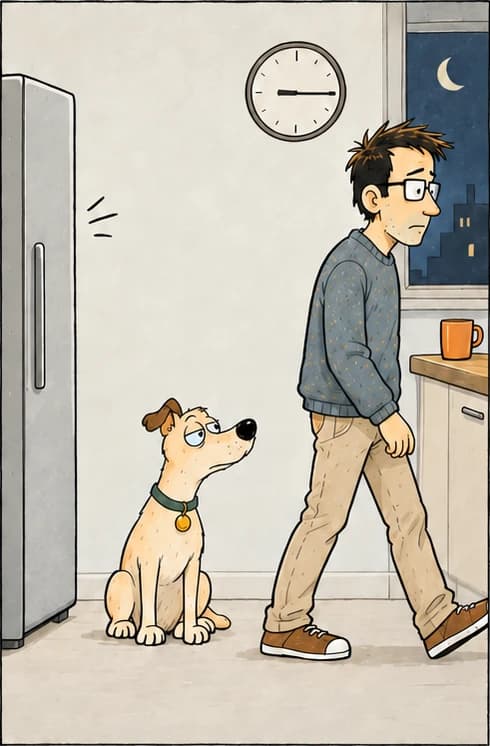
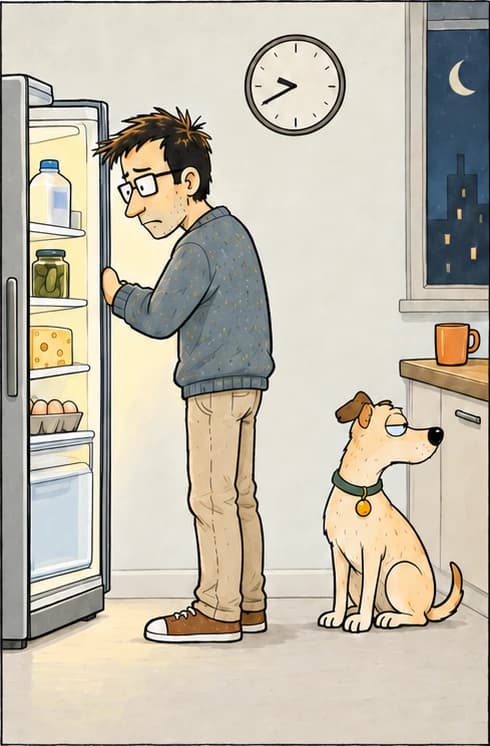
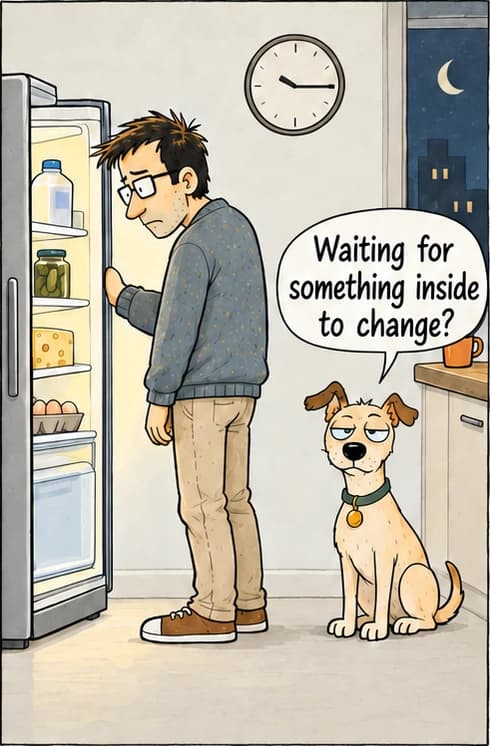
The dog says something about people in general, and the man immediately asks whether he means him. Before you look at the comic, answer silently: when someone says "people are…", how often do you apply it to yourself?
ComicThe dog talks, only the man can hear it. Below the comic: what experiments say about it.
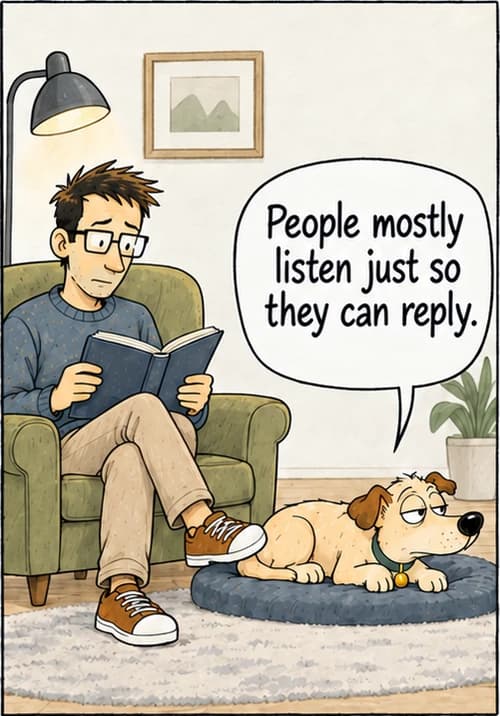



Psíchologie, episode 2 · You mean me?
The man volunteered himself. The dog was talking about people, not about him. But when a general sentence fits us even a little, we hear it as a sentence about ourselves. And general sentences fit almost everyone.
Try it on yourself. Based on a single choice, the dog will tell you what you're like.
IllustrationIt runs one well-known experiment on you. Your choices aren't stored anywhere.

Pick the book you'd open tonight. Based on it, I'll tell you what you're like.
It's one of psychology's best-known experiments. In 1948 Bertram Forer gave 39 students a personality test and a week later handed each of them "their" description. Everyone got the same one, mostly copied from a newsstand astrology book. On a scale of 0 to 5 they rated how well it fit them at about 4.3 on average.
A sentence about everyone sounds like a sentence about me. That's why the man volunteered.
So is the dog right? Partly. He didn't come up with the line himself, by the way: Stephen Covey wrote it almost word for word in 1989 in The 7 Habits of Highly Effective People. Diana Tamir and Jason Mitchell (2012) start from the estimate that people devote 30 to 40% of what they say to their own experiences and opinions. In their experiments, people even gave up some money just to be able to talk about themselves.
What helps: a follow-up question. People who asked more questions in a conversation, especially follow-up ones ("And how did it turn out?"), were liked more by their partners. At speed dating they more often got a yes to a second date. They didn't expect it themselves (Huang et al. 2017).
Related articleNobody's watching you as much as you think →Why we think others watch us more than they really do. Related articleDo they see you the same way? →Guess how many friends see you the way you see yourself. Then find out at a table.Sources
- Forer, B. R. (1949). The fallacy of personal validation: A classroom demonstration of gullibility. Journal of Abnormal and Social Psychology, 44(1), 118–123
- Dickson, D. H. and Kelly, I. W. (1985). The "Barnum effect" in personality assessment: A review of the literature. Psychological Reports, 57(2), 367–382
- Covey, S. R. (1989). The 7 Habits of Highly Effective People. New York: Free Press.
- Tamir, D. I. and Mitchell, J. P. (2012). Disclosing information about the self is intrinsically rewarding. Proceedings of the National Academy of Sciences, 109(21), 8038–8043
- Huang, K., Yeomans, M., Brooks, A. W., Minson, J. and Gino, F. (2017). It doesn't hurt to ask: Question-asking increases liking. Journal of Personality and Social Psychology, 113(3), 430–452
- Aron, A., Melinat, E., Aron, E. N., Vallone, R. D. and Bator, R. J. (1997). The experimental generation of interpersonal closeness: A procedure and some preliminary findings. Personality and Social Psychology Bulletin, 23(4), 363–377